




Some patients feel apprehensive when they hear the words “root canal treatment”. Many associate it with pain, a weaker tooth or future complications, often based on ideas that circulate without any clinical basis.
However, root canal treatment (endodontic treatment) is a safe, effective and increasingly modern procedure. When performed by an experienced professional with the right resources, it preserves the natural tooth and restores its function in a stable way.
This article clears up the main myths about root-canal-treated teeth, with clear, reliable information based on clinical experience and the technology available at our clinic.
Atelier do Sorriso is in Almancil, Faro, in the centre of the Algarve, where we welcome patients from across the region — both Portuguese and international residents looking for high-quality dental treatment focused on aesthetics, durability and comfort.
What Is a Root-Canal-Treated Tooth?
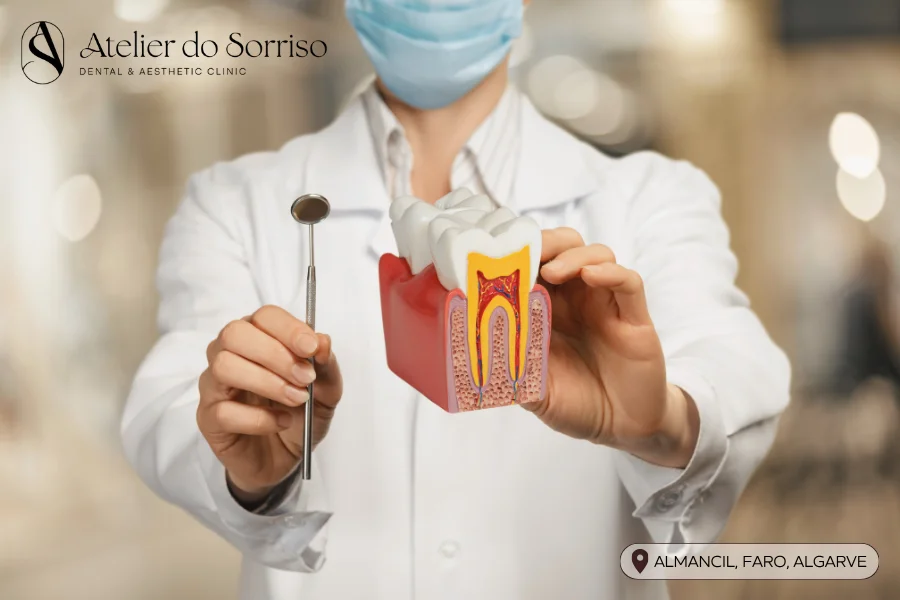
A root-canal-treated tooth is one whose pulp has been removed, usually because of infection, deep decay or trauma. The pulp is the soft tissue inside the tooth that contains nerves and blood vessels. When it is compromised, it can cause severe pain and, if untreated, lead to tooth loss.
Root canal treatment removes the pulp completely, carefully cleans the root canals and fills them with a biocompatible material. The procedure eliminates the pain and stops the infection from spreading.
Although the tooth no longer feels hot and cold, it keeps working normally for chewing and maintains its structural role in the arch. How long it lasts depends on the quality of the treatment and of the final restoration, which must protect the treated tooth properly.
With the right care, a root-canal-treated tooth can stay functional and aesthetically stable for many years, without any symptoms or limitations.
7 Myths About Root-Canal-Treated Teeth
1. “A root-canal-treated tooth will always hurt”
People often associate a root-canal-treated tooth with persistent pain, but this does not match clinical reality. The main aim of root canal treatment is precisely to eliminate the pain caused by inflammation or infection of the pulp.
During the procedure, the nerve tissue inside the tooth is removed, so it no longer feels temperature or pain. Once the treatment is complete, the tooth should not cause any significant discomfort.
It is normal, however, to feel slight discomfort in the first days after treatment, because the tissues around the root have been handled. This is temporary and usually goes away with simple painkillers and rest.
If pain appears weeks or months later, it may indicate a residual infection or a problem with the final restoration. In these cases, see your dentist for a re-assessment and, if needed, further treatment.
At our clinic in Almancil, Algarve, we follow strict protocols to decontaminate and seal the canals, which greatly reduces the risk of complications. When done well, root canal treatment brings pain relief and long-term stability.
2. “Root canal treatment weakens the root”
One of the most common misconceptions is that root canal treatment weakens the tooth’s root. In reality, the root keeps its structure and supporting function after treatment. What may become more vulnerable is the crown of the tooth, especially if it was already compromised by decay or a fracture.
Only the inside of the tooth is treated — the root canals — where the pulp is removed, the infection cleaned and the canals filled with a sealing material. This does not change the strength of the root or how it sits in the jawbone.
After treatment, however, the crown of the tooth may become more fragile, especially if a lot of tissue has been lost. In these cases, it is essential to restore it with a composite restoration or a crown to prevent future fractures.
At Atelier do Sorriso we assess each case individually. When needed, we reinforce the tooth with a fibre post and high-strength adhesive materials, for durability and stability without compromising aesthetics.
So what weakens the tooth is not the root canal treatment itself, but the lack of proper restorative planning afterwards. When this is done correctly, the root stays healthy and functional for many years.
3. “A root-canal-treated tooth always turns dark”
It is true that some teeth can darken after root canal treatment, but saying it always happens is a myth. Darkening depends on several factors, including the condition of the tooth before treatment, the materials used and the technique.
In most cases, discolouration is linked to blood residues inside the canal or to tissue breakdown when it has not been fully removed. It can also happen when the tooth suffered trauma before treatment, which affects its colour even before the procedure.
With current irrigation, cleaning and filling methods, this risk can be minimised. The materials used for filling and for the final restoration are tooth-coloured and colour-stable, which helps keep the smile looking natural.
If the tooth still darkens over time, there are effective aesthetic solutions, such as internal whitening (done only on the treated tooth), composite veneers or ceramic restorations, which restore the original colour without extraction.
At Atelier do Sorriso, aesthetics is a priority, especially for visible teeth. That is why root canal treatment is always planned with attention to the final result — both functional and aesthetic.
4. “It is better to extract the tooth than to have a root canal”
This is one of the most harmful myths, and unfortunately still widely shared. Tooth extraction should always be the last option. Keeping the natural tooth is, in most cases, the best solution — functionally, financially and biologically.
A correctly treated tooth can stay stable for many years. When a tooth is extracted, the empty space can affect chewing, cause neighbouring teeth to shift and lead to bone loss in the area.
Replacing a natural tooth with a dental implant is a valid alternative, but it is more invasive, more expensive and takes longer to recover from. Whenever the tooth still has viable structure, root canal treatment is the most conservative way to keep it.
At Atelier do Sorriso we assess each case carefully, with X-rays and clinical examinations, so that extraction is only carried out when it is really necessary. The decision is always well founded, with the aim of protecting your long-term oral health.
Keeping the natural tooth whenever possible is the basis of modern, responsible dentistry.
5. “Root-canal-treated teeth need no care”
The fact that a tooth has had root canal treatment does not mean it is free from problems forever. Although it no longer feels pain, it is still vulnerable to decay, fractures, leaking restorations and other wear.
Without the pulp, the tooth no longer responds to painful stimuli, so problems can develop without the patient noticing, which makes regular check-ups even more important.
Another important point is the need for a proper final restoration. When the crown of the tooth is compromised, the ideal is to protect it with a dental crown or an indirect restoration, for chewing strength and a long-lasting result.
Good oral hygiene, correct brushing and flossing, and attending check-ups are essential to avoid complications. Professional follow-up allows early detection of any sign of a failed seal or worn restorative materials.
At Atelier do Sorriso we follow all patients closely after root canal treatment, advising them on the care needed and checking the restoration over time.
6. “Root canal treatment causes problems elsewhere in the body”
This claim has no valid scientific basis. The idea that root canal treatment causes systemic diseases or problems in other organs comes from old theories that have been disproved by the most credible scientific bodies.
Studies in the early 20th century suggested links between treated teeth and diseases elsewhere in the body. However, they were later refuted for lack of methodology and evidence. Today, modern endodontics is a safe practice recognised by the main international dental associations.
With current protocols — including aseptic techniques, mechanised instrumentation, effective chemical irrigation and biocompatible sealing materials — the risk of failure or persistent infection is minimal.
In fact, it is leaving an infection untreated that can have systemic consequences. Root canal treatment removes that source of infection, protecting the patient’s general health.
At Atelier do Sorriso we follow strict, evidence-based protocols for safe, controlled treatment. There is no reason to believe that a properly treated tooth poses any risk to the body.
7. “Root canal treatment has a poor prognosis”
The success rate of root canal treatment is very high today — in many cases over 90%, as long as it is performed with the right methods and followed by an effective restoration. This completely contradicts the idea that it has a poor prognosis.
The long-term result depends mainly on three factors: the quality of the treatment, the final restoration of the tooth (a filling or crown, as needed) and regular follow-up over the years.
Failures mainly occur in poorly performed cases, with canals not fully cleaned or sealed, no proper isolation, or when the tooth is left without a permanent restoration for a long time. In these cases, reinfection or even a fracture can occur.
In recent years, endodontics has evolved significantly, with technologies such as nickel-titanium rotary files, digital X-rays and apex locators that increase precision and reduce the chances of failure.
At Atelier do Sorriso every step of root canal treatment is carried out with precision and care, for the best possible prognosis. When done well, it preserves the tooth for many years, without pain or limitations.
How We Carry Out the Treatment at Our Clinic in the Algarve
At Atelier do Sorriso, root canal treatment is carried out with clinical rigour, modern technology and complete focus on patient comfort. Our aim is to preserve the natural tooth as safely as possible, minimising the risk of future complications.
The process begins with a detailed assessment and a digital X-ray, which gives a clear view of the root canals. We use rubber dam isolation to prevent contamination and keep the working field sterile.
The canals are cleaned with mechanised instruments, which offer more precision and shorten the procedure. At the same time, irrigating solutions remove bacteria and organic debris in depth.
Once clean and disinfected, the canals are sealed with biocompatible materials that prevent reinfection. In many cases, treatment is completed in a single session, depending on the complexity and condition of the tooth.
Finally, a temporary or permanent restoration is placed, according to the plan. When the tooth has lost a lot of structure, we recommend a dental crown for protection and durability.
With proper follow-up and the right restoration, the treated tooth keeps its chewing function, without pain and with an excellent aesthetic result.
What to Do After Root Canal Treatment?
After root canal treatment, it is essential to follow some guidelines for the tissues to heal and the procedure to succeed in the long term. Although the tooth no longer has a nerve, it still plays an important role in chewing and in the stability of the arch.
In the first 24 to 48 hours, you may feel slight discomfort or sensitivity when chewing. Choose softer foods and avoid biting directly on the treated tooth, especially if it has a temporary filling.
Good oral hygiene is crucial: brush carefully and floss daily. Although the tooth has been treated, it can still develop decay or leaks around the restoration without regular care.
Another important step is not to delay the permanent restoration, such as a ceramic crown or an onlay, when this is recommended. Without it, the risk of fracture increases, especially in back teeth that take more chewing load.
At Atelier do Sorriso every patient receives individual instructions after root canal treatment, including follow-up appointments to check the restoration and periapical health over the long term.
When Should You Seek Help?
Although root canal treatment is safe and highly successful, there are situations in which you should be alert and see the dentist without delay.
Some symptoms may indicate that something did not go as expected or that a new complication has appeared. Early intervention can avoid more serious problems and save the treated tooth.
Book an appointment as soon as possible if you notice:
- Persistent pain in the treated tooth, even a few days after treatment
- Swelling of the gum around the tooth
- A fistula (small pus-filled bump) near the root
- A loose tooth
- A temporary filling coming loose or leaking
- Rapid, visible darkening of the tooth after treatment
These signs may indicate a residual infection, a broken filling material or a failed canal seal. Most of the time they can be solved with root canal retreatment or a new restoration.
At Atelier do Sorriso we can see urgent cases and carry out further examinations quickly, giving our patients in the Algarve safety and peace of mind.
Living Without Fear: Root Canal Treatment Is Also Care
Debunking the myths about root-canal-treated teeth is essential for informed decisions and calmer treatment. Root canal treatment is a safe, routine and highly effective procedure that preserves teeth that would otherwise be lost.
With today’s resources, it is possible to eliminate pain, treat the infection and restore the tooth’s function and appearance — all with comfort and personalised follow-up. What matters is acting in time and relying on an experienced team and modern equipment.
At Atelier do Sorriso we are ready to assess your case rigorously, answer your questions and offer an approach centred on you — without pressure and with complete transparency.
Book Your Appointment with Us: Atelier do Sorriso Clinic
Give your smile the care it deserves — with confidence, clarity and safety.
📍 Address: Rua João de Deus, Lote 1C, Almancil, Algarve (See on Maps)